Java Is Open Source Programming Language You Can Download From Java and Java Libraries From http://www.oracle.com.
We provide this code related to title for you to solve your developing problem easily. Libraries which is import in this program you can download from http://www.oracle.com.
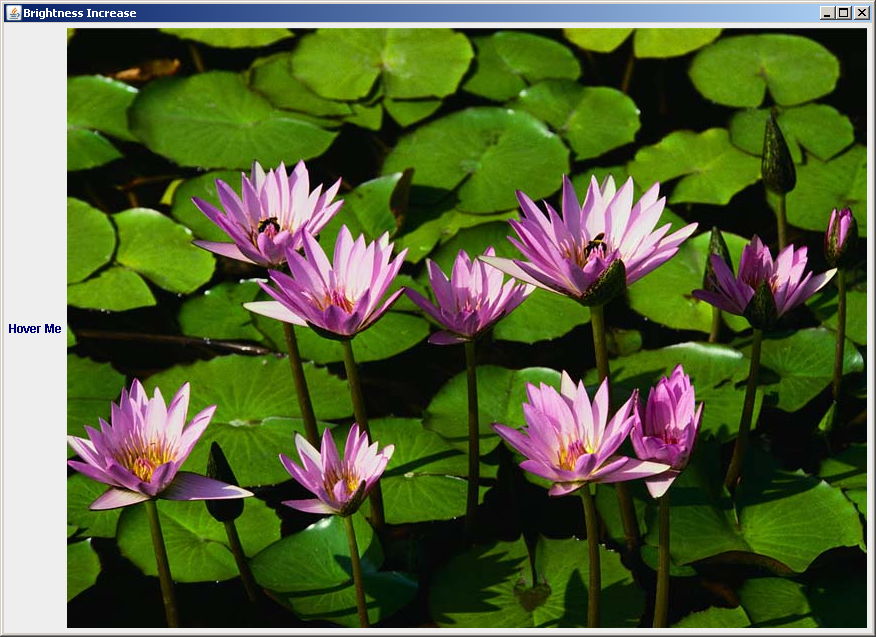
Brightness Increase Demo
import java.awt.Color;
import java.awt.FlowLayout;
import java.awt.event.MouseAdapter;
import java.awt.event.MouseEvent;
import java.awt.image.BufferedImage;
import java.awt.image.RescaleOp;
import java.io.IOException;
import javax.imageio.ImageIO;
import javax.swing.ImageIcon;
import javax.swing.JComponent;
import javax.swing.JFrame;
import javax.swing.JLabel;
import javax.swing.SwingUtilities;
import javax.swing.UIManager;
import javax.swing.UnsupportedLookAndFeelException;
import java.awt.image.BufferedImage;
import java.awt.image.ColorModel;
import java.awt.image.Raster;
import java.awt.image.WritableRaster;
import java.awt.GraphicsConfiguration;
import java.awt.Transparency;
import java.awt.Graphics;
import java.awt.GraphicsEnvironment;
import java.awt.Graphics2D;
import java.awt.RenderingHints;
import java.io.IOException;
import java.net.URL;
import javax.imageio.ImageIO;
/**
*
* @author Romain Guy <romain.guy@mac.com>
*/
public class BrightnessIncreaseDemo extends JFrame {
private JLabel textLabel;
private JLabel imageLabel;
private BufferedImage image;
public BrightnessIncreaseDemo() {
super("Brightness Increase");
getContentPane().setLayout(new FlowLayout());
textLabel = new JLabel("Hover Me");
textLabel.setForeground(new Color(0, 0, 120));
textLabel.addMouseListener(new MouseAdapter() {
@Override
public void mouseEntered(MouseEvent e) {
increaseTextBrightness((JComponent) e.getSource());
}
@Override
public void mouseExited(MouseEvent e) {
decreaseTextBrightness((JComponent) e.getSource());
}
});
add(textLabel);
try {
image = GraphicsUtilities.loadCompatibleImage(getClass().getResource("A.png"));
} catch (IOException ex) {
ex.printStackTrace();
}
imageLabel = new JLabel(new ImageIcon(image));
imageLabel.addMouseListener(new MouseAdapter() {
@Override
public void mouseEntered(MouseEvent e) {
increaseImageBrightness((JLabel) e.getSource(), image);
}
@Override
public void mouseExited(MouseEvent e) {
decreaseImageBrightness((JLabel) e.getSource(), image);
}
});
add(imageLabel);
pack();
setLocationRelativeTo(null);
setDefaultCloseOperation(JFrame.EXIT_ON_CLOSE);
}
public static void increaseImageBrightness(JLabel c, BufferedImage image) {
float[] factors = new float[] {
1.4f, 1.4f, 1.4f, 1.4f
};
float[] offsets = new float[] {
0.0f, 0.0f, 0.0f, 0.0f
};
RescaleOp op = new RescaleOp(factors, offsets, null);
BufferedImage brighter = op.filter(image, null);
c.setIcon(new ImageIcon(brighter));
}
public static void decreaseImageBrightness(JLabel c, BufferedImage image) {
c.setIcon(new ImageIcon(image));
}
public static void increaseTextBrightness(JComponent c) {
Color color = c.getForeground();
c.putClientProperty("mouseover_brightness", color);
float[] hsb = Color.RGBtoHSB(color.getRed(), color.getGreen(), color.getBlue(), null);
hsb[2] = Math.min(1.0f, hsb[2] * 2.0f);
c.setForeground(Color.getHSBColor(hsb[0], hsb[1], hsb[2]));
}
public static void decreaseTextBrightness(JComponent c) {
Color color = (Color) c.getClientProperty("mouseover_brightness");
c.setForeground(color);
}
public static void main(String... args) {
try {
UIManager.setLookAndFeel(UIManager.getCrossPlatformLookAndFeelClassName());
} catch (UnsupportedLookAndFeelException ex) {
ex.printStackTrace();
} catch (ClassNotFoundException ex) {
ex.printStackTrace();
} catch (IllegalAccessException ex) {
ex.printStackTrace();
} catch (InstantiationException ex) {
ex.printStackTrace();
}
SwingUtilities.invokeLater(new Runnable() {
public void run() {
new BrightnessIncreaseDemo().setVisible(true);
}
});
}
}
/**
* <p><code>GraphicsUtilities</code> contains a set of tools to perform
* common graphics operations easily. These operations are divided into
* several themes, listed below.</p>
* <h2>Compatible Images</h2>
* <p>Compatible images can, and should, be used to increase drawing
* performance. This class provides a number of methods to load compatible
* images directly from files or to convert existing images to compatibles
* images.</p>
* <h2>Creating Thumbnails</h2>
* <p>This class provides a number of methods to easily scale down images.
* Some of these methods offer a trade-off between speed and result quality and
* shouuld be used all the time. They also offer the advantage of producing
* compatible images, thus automatically resulting into better runtime
* performance.</p>
* <p>All these methodes are both faster than
* {@link java.awt.Image#getScaledInstance(int, int, int)} and produce
* better-looking results than the various <code>drawImage()</code> methods
* in {@link java.awt.Graphics}, which can be used for image scaling.</p>
* <h2>Image Manipulation</h2>
* <p>This class provides two methods to get and set pixels in a buffered image.
* These methods try to avoid unmanaging the image in order to keep good
* performance.</p>
*
* @author Romain Guy <romain.guy@mac.com>
*/
class GraphicsUtilities {
private GraphicsUtilities() {
}
// Returns the graphics configuration for the primary screen
private static GraphicsConfiguration getGraphicsConfiguration() {
return GraphicsEnvironment.getLocalGraphicsEnvironment().
getDefaultScreenDevice().getDefaultConfiguration();
}
/**
* <p>Returns a new <code>BufferedImage</code> using the same color model
* as the image passed as a parameter. The returned image is only compatible
* with the image passed as a parameter. This does not mean the returned
* image is compatible with the hardware.</p>
*
* @param image the reference image from which the color model of the new
* image is obtained
* @return a new <code>BufferedImage</code>, compatible with the color model
* of <code>image</code>
*/
public static BufferedImage createColorModelCompatibleImage(BufferedImage image) {
ColorModel cm = image.getColorModel();
return new BufferedImage(cm,
cm.createCompatibleWritableRaster(image.getWidth(),
image.getHeight()),
cm.isAlphaPremultiplied(), null);
}
/**
* <p>Returns a new compatible image with the same width, height and
* transparency as the image specified as a parameter.</p>
*
* @see java.awt.Transparency
* @see #createCompatibleImage(int, int)
* @see #createCompatibleImage(java.awt.image.BufferedImage, int, int)
* @see #createCompatibleTranslucentImage(int, int)
* @see #loadCompatibleImage(java.net.URL)
* @see #toCompatibleImage(java.awt.image.BufferedImage)
* @param image the reference image from which the dimension and the
* transparency of the new image are obtained
* @return a new compatible <code>BufferedImage</code> with the same
* dimension and transparency as <code>image</code>
*/
public static BufferedImage createCompatibleImage(BufferedImage image) {
return createCompatibleImage(image, image.getWidth(), image.getHeight());
}
/**
* <p>Returns a new compatible image of the specified width and height, and
* the same transparency setting as the image specified as a parameter.</p>
*
* @see java.awt.Transparency
* @see #createCompatibleImage(java.awt.image.BufferedImage)
* @see #createCompatibleImage(int, int)
* @see #createCompatibleTranslucentImage(int, int)
* @see #loadCompatibleImage(java.net.URL)
* @see #toCompatibleImage(java.awt.image.BufferedImage)
* @param width the width of the new image
* @param height the height of the new image
* @param image the reference image from which the transparency of the new
* image is obtained
* @return a new compatible <code>BufferedImage</code> with the same
* transparency as <code>image</code> and the specified dimension
*/
public static BufferedImage createCompatibleImage(BufferedImage image,
int width, int height) {
return getGraphicsConfiguration().createCompatibleImage(width, height,
image.getTransparency());
}
/**
* <p>Returns a new opaque compatible image of the specified width and
* height.</p>
*
* @see #createCompatibleImage(java.awt.image.BufferedImage)
* @see #createCompatibleImage(java.awt.image.BufferedImage, int, int)
* @see #createCompatibleTranslucentImage(int, int)
* @see #loadCompatibleImage(java.net.URL)
* @see #toCompatibleImage(java.awt.image.BufferedImage)
* @param width the width of the new image
* @param height the height of the new image
* @return a new opaque compatible <code>BufferedImage</code> of the
* specified width and height
*/
public static BufferedImage createCompatibleImage(int width, int height) {
return getGraphicsConfiguration().createCompatibleImage(width, height);
}
/**
* <p>Returns a new translucent compatible image of the specified width
* and height.</p>
*
* @see #createCompatibleImage(java.awt.image.BufferedImage)
* @see #createCompatibleImage(java.awt.image.BufferedImage, int, int)
* @see #createCompatibleImage(int, int)
* @see #loadCompatibleImage(java.net.URL)
* @see #toCompatibleImage(java.awt.image.BufferedImage)
* @param width the width of the new image
* @param height the height of the new image
* @return a new translucent compatible <code>BufferedImage</code> of the
* specified width and height
*/
public static BufferedImage createCompatibleTranslucentImage(int width,
int height) {
return getGraphicsConfiguration().createCompatibleImage(width, height,
Transparency.TRANSLUCENT);
}
/**
* <p>Returns a new compatible image from a URL. The image is loaded from the
* specified location and then turned, if necessary into a compatible
* image.</p>
*
* @see #createCompatibleImage(java.awt.image.BufferedImage)
* @see #createCompatibleImage(java.awt.image.BufferedImage, int, int)
* @see #createCompatibleImage(int, int)
* @see #createCompatibleTranslucentImage(int, int)
* @see #toCompatibleImage(java.awt.image.BufferedImage)
* @param resource the URL of the picture to load as a compatible image
* @return a new translucent compatible <code>BufferedImage</code> of the
* specified width and height
* @throws java.io.IOException if the image cannot be read or loaded
*/
public static BufferedImage loadCompatibleImage(URL resource)
throws IOException {
BufferedImage image = ImageIO.read(resource);
return toCompatibleImage(image);
}
/**
* <p>Return a new compatible image that contains a copy of the specified
* image. This method ensures an image is compatible with the hardware,
* and therefore optimized for fast blitting operations.</p>
*
* @see #createCompatibleImage(java.awt.image.BufferedImage)
* @see #createCompatibleImage(java.awt.image.BufferedImage, int, int)
* @see #createCompatibleImage(int, int)
* @see #createCompatibleTranslucentImage(int, int)
* @see #loadCompatibleImage(java.net.URL)
* @param image the image to copy into a new compatible image
* @return a new compatible copy, with the
* same width and height and transparency and content, of <code>image</code>
*/
public static BufferedImage toCompatibleImage(BufferedImage image) {
if (image.getColorModel().equals(
getGraphicsConfiguration().getColorModel())) {
return image;
}
BufferedImage compatibleImage =
getGraphicsConfiguration().createCompatibleImage(
image.getWidth(), image.getHeight(),
image.getTransparency());
Graphics g = compatibleImage.getGraphics();
g.drawImage(image, 0, 0, null);
g.dispose();
return compatibleImage;
}
/**
* <p>Returns a thumbnail of a source image. <code>newSize</code> defines
* the length of the longest dimension of the thumbnail. The other
* dimension is then computed according to the dimensions ratio of the
* original picture.</p>
* <p>This method favors speed over quality. When the new size is less than
* half the longest dimension of the source image,
* {@link #createThumbnail(BufferedImage, int)} or
* {@link #createThumbnail(BufferedImage, int, int)} should be used instead
* to ensure the quality of the result without sacrificing too much
* performance.</p>
*
* @see #createThumbnailFast(java.awt.image.BufferedImage, int, int)
* @see #createThumbnail(java.awt.image.BufferedImage, int)
* @see #createThumbnail(java.awt.image.BufferedImage, int, int)
* @param image the source image
* @param newSize the length of the largest dimension of the thumbnail
* @return a new compatible <code>BufferedImage</code> containing a
* thumbnail of <code>image</code>
* @throws IllegalArgumentException if <code>newSize</code> is larger than
* the largest dimension of <code>image</code> or <= 0
*/
public static BufferedImage createThumbnailFast(BufferedImage image,
int newSize) {
float ratio;
int width = image.getWidth();
int height = image.getHeight();
if (width > height) {
if (newSize >= width) {
throw new IllegalArgumentException("newSize must be lower than" +
" the image width");
} else if (newSize <= 0) {
throw new IllegalArgumentException("newSize must" +
" be greater than 0");
}
ratio = (float) width / (float) height;
width = newSize;
height = (int) (newSize / ratio);
} else {
if (newSize >= height) {
throw new IllegalArgumentException("newSize must be lower than" +
" the image height");
} else if (newSize <= 0) {
throw new IllegalArgumentException("newSize must" +
" be greater than 0");
}
ratio = (float) height / (float) width;
height = newSize;
width = (int) (newSize / ratio);
}
BufferedImage temp = createCompatibleImage(image, width, height);
Graphics2D g2 = temp.createGraphics();
g2.setRenderingHint(RenderingHints.KEY_INTERPOLATION,
RenderingHints.VALUE_INTERPOLATION_BILINEAR);
g2.drawImage(image, 0, 0, temp.getWidth(), temp.getHeight(), null);
g2.dispose();
return temp;
}
/**
* <p>Returns a thumbnail of a source image.</p>
* <p>This method favors speed over quality. When the new size is less than
* half the longest dimension of the source image,
* {@link #createThumbnail(BufferedImage, int)} or
* {@link #createThumbnail(BufferedImage, int, int)} should be used instead
* to ensure the quality of the result without sacrificing too much
* performance.</p>
*
* @see #createThumbnailFast(java.awt.image.BufferedImage, int)
* @see #createThumbnail(java.awt.image.BufferedImage, int)
* @see #createThumbnail(java.awt.image.BufferedImage, int, int)
* @param image the source image
* @param newWidth the width of the thumbnail
* @param newHeight the height of the thumbnail
* @return a new compatible <code>BufferedImage</code> containing a
* thumbnail of <code>image</code>
* @throws IllegalArgumentException if <code>newWidth</code> is larger than
* the width of <code>image</code> or if code>newHeight</code> is larger
* than the height of <code>image</code> or if one of the dimensions
* is <= 0
*/
public static BufferedImage createThumbnailFast(BufferedImage image,
int newWidth, int newHeight) {
if (newWidth >= image.getWidth() ||
newHeight >= image.getHeight()) {
throw new IllegalArgumentException("newWidth and newHeight cannot" +
" be greater than the image" +
" dimensions");
} else if (newWidth <= 0 || newHeight <= 0) {
throw new IllegalArgumentException("newWidth and newHeight must" +
" be greater than 0");
}
BufferedImage temp = createCompatibleImage(image, newWidth, newHeight);
Graphics2D g2 = temp.createGraphics();
g2.setRenderingHint(RenderingHints.KEY_INTERPOLATION,
RenderingHints.VALUE_INTERPOLATION_BILINEAR);
g2.drawImage(image, 0, 0, temp.getWidth(), temp.getHeight(), null);
g2.dispose();
return temp;
}
/**
* <p>Returns a thumbnail of a source image. <code>newSize</code> defines
* the length of the longest dimension of the thumbnail. The other
* dimension is then computed according to the dimensions ratio of the
* original picture.</p>
* <p>This method offers a good trade-off between speed and quality.
* The result looks better than
* {@link #createThumbnailFast(java.awt.image.BufferedImage, int)} when
* the new size is less than half the longest dimension of the source
* image, yet the rendering speed is almost similar.</p>
*
* @see #createThumbnailFast(java.awt.image.BufferedImage, int, int)
* @see #createThumbnailFast(java.awt.image.BufferedImage, int)
* @see #createThumbnail(java.awt.image.BufferedImage, int, int)
* @param image the source image
* @param newSize the length of the largest dimension of the thumbnail
* @return a new compatible <code>BufferedImage</code> containing a
* thumbnail of <code>image</code>
* @throws IllegalArgumentException if <code>newSize</code> is larger than
* the largest dimension of <code>image</code> or <= 0
*/
public static BufferedImage createThumbnail(BufferedImage image,
int newSize) {
int width = image.getWidth();
int height = image.getHeight();
boolean isWidthGreater = width > height;
if (isWidthGreater) {
if (newSize >= width) {
throw new IllegalArgumentException("newSize must be lower than" +
" the image width");
}
} else if (newSize >= height) {
throw new IllegalArgumentException("newSize must be lower than" +
" the image height");
}
if (newSize <= 0) {
throw new IllegalArgumentException("newSize must" +
" be greater than 0");
}
float ratioWH = (float) width / (float) height;
float ratioHW = (float) height / (float) width;
BufferedImage thumb = image;
do {
if (isWidthGreater) {
width /= 2;
if (width < newSize) {
width = newSize;
}
height = (int) (width / ratioWH);
} else {
height /= 2;
if (height < newSize) {
height = newSize;
}
width = (int) (height / ratioHW);
}
BufferedImage temp = createCompatibleImage(image, width, height);
Graphics2D g2 = temp.createGraphics();
g2.setRenderingHint(RenderingHints.KEY_INTERPOLATION,
RenderingHints.VALUE_INTERPOLATION_BILINEAR);
g2.drawImage(thumb, 0, 0, temp.getWidth(), temp.getHeight(), null);
g2.dispose();
thumb = temp;
} while (newSize != (isWidthGreater ? width : height));
return thumb;
}
/**
* <p>Returns a thumbnail of a source image.</p>
* <p>This method offers a good trade-off between speed and quality.
* The result looks better than
* {@link #createThumbnailFast(java.awt.image.BufferedImage, int)} when
* the new size is less than half the longest dimension of the source
* image, yet the rendering speed is almost similar.</p>
*
* @see #createThumbnailFast(java.awt.image.BufferedImage, int)
* @see #createThumbnailFast(java.awt.image.BufferedImage, int, int)
* @see #createThumbnail(java.awt.image.BufferedImage, int)
* @param image the source image
* @param newWidth the width of the thumbnail
* @param newHeight the height of the thumbnail
* @return a new compatible <code>BufferedImage</code> containing a
* thumbnail of <code>image</code>
* @throws IllegalArgumentException if <code>newWidth</code> is larger than
* the width of <code>image</code> or if code>newHeight</code> is larger
* than the height of <code>image or if one the dimensions is not > 0</code>
*/
public static BufferedImage createThumbnail(BufferedImage image,
int newWidth, int newHeight) {
int width = image.getWidth();
int height = image.getHeight();
if (newWidth >= width || newHeight >= height) {
throw new IllegalArgumentException("newWidth and newHeight cannot" +
" be greater than the image" +
" dimensions");
} else if (newWidth <= 0 || newHeight <= 0) {
throw new IllegalArgumentException("newWidth and newHeight must" +
" be greater than 0");
}
BufferedImage thumb = image;
do {
if (width > newWidth) {
width /= 2;
if (width < newWidth) {
width = newWidth;
}
}
if (height > newHeight) {
height /= 2;
if (height < newHeight) {
height = newHeight;
}
}
BufferedImage temp = createCompatibleImage(image, width, height);
Graphics2D g2 = temp.createGraphics();
g2.setRenderingHint(RenderingHints.KEY_INTERPOLATION,
RenderingHints.VALUE_INTERPOLATION_BILINEAR);
g2.drawImage(thumb, 0, 0, temp.getWidth(), temp.getHeight(), null);
g2.dispose();
thumb = temp;
} while (width != newWidth || height != newHeight);
return thumb;
}
/**
* <p>Returns an array of pixels, stored as integers, from a
* <code>BufferedImage</code>. The pixels are grabbed from a rectangular
* area defined by a location and two dimensions. Calling this method on
* an image of type different from <code>BufferedImage.TYPE_INT_ARGB</code>
* and <code>BufferedImage.TYPE_INT_RGB</code> will unmanage the image.</p>
*
* @param img the source image
* @param x the x location at which to start grabbing pixels
* @param y the y location at which to start grabbing pixels
* @param w the width of the rectangle of pixels to grab
* @param h the height of the rectangle of pixels to grab
* @param pixels a pre-allocated array of pixels of size w*h; can be null
* @return <code>pixels</code> if non-null, a new array of integers
* otherwise
* @throws IllegalArgumentException is <code>pixels</code> is non-null and
* of length < w*h
*/
public static int[] getPixels(BufferedImage img,
int x, int y, int w, int h, int[] pixels) {
if (w == 0 || h == 0) {
return new int[0];
}
if (pixels == null) {
pixels = new int[w * h];
} else if (pixels.length < w * h) {
throw new IllegalArgumentException("pixels array must have a length" +
" >= w*h");
}
int imageType = img.getType();
if (imageType == BufferedImage.TYPE_INT_ARGB ||
imageType == BufferedImage.TYPE_INT_RGB) {
Raster raster = img.getRaster();
return (int[]) raster.getDataElements(x, y, w, h, pixels);
}
// Unmanages the image
return img.getRGB(x, y, w, h, pixels, 0, w);
}
/**
* <p>Writes a rectangular area of pixels in the destination
* <code>BufferedImage</code>. Calling this method on
* an image of type different from <code>BufferedImage.TYPE_INT_ARGB</code>
* and <code>BufferedImage.TYPE_INT_RGB</code> will unmanage the image.</p>
*
* @param img the destination image
* @param x the x location at which to start storing pixels
* @param y the y location at which to start storing pixels
* @param w the width of the rectangle of pixels to store
* @param h the height of the rectangle of pixels to store
* @param pixels an array of pixels, stored as integers
* @throws IllegalArgumentException is <code>pixels</code> is non-null and
* of length < w*h
*/
public static void setPixels(BufferedImage img,
int x, int y, int w, int h, int[] pixels) {
if (pixels == null || w == 0 || h == 0) {
return;
} else if (pixels.length < w * h) {
throw new IllegalArgumentException("pixels array must have a length" +
" >= w*h");
}
int imageType = img.getType();
if (imageType == BufferedImage.TYPE_INT_ARGB ||
imageType == BufferedImage.TYPE_INT_RGB) {
WritableRaster raster = img.getRaster();
raster.setDataElements(x, y, w, h, pixels);
} else {
// Unmanages the image
img.setRGB(x, y, w, h, pixels, 0, w);
}
}
}