Java Is Open Source Programming Language You Can Download From Java and Java Libraries From http://www.oracle.com.
We provide this code related to title for you to solve your developing problem easily. Libraries which is import in this program you can download from http://www.oracle.com.
MouseRotateApp renders a single, interactively rotatable cube
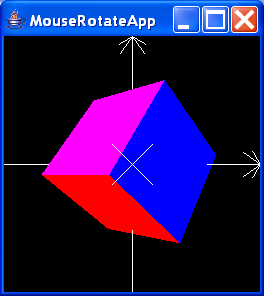
/*
 * @(#)MouseRotateApp.java 1.0 99/03/25 11:42:40
 *
 * Copyright (c) 1996-1999 Sun Microsystems, Inc. All Rights Reserved.
 *
 * Sun grants you ("Licensee") a non-exclusive, royalty free, license to use,
 * modify and redistribute this software in source and binary code form,
 * provided that i) this copyright notice and license appear on all copies of
 * the software; and ii) Licensee does not utilize the software in a manner
 * which is disparaging to Sun.
 *
 * This software is provided "AS IS," without a warranty of any kind. ALL
 * EXPRESS OR IMPLIED CONDITIONS, REPRESENTATIONS AND WARRANTIES, INCLUDING ANY
 * IMPLIED WARRANTY OF MERCHANTABILITY, FITNESS FOR A PARTICULAR PURPOSE OR
 * NON-INFRINGEMENT, ARE HEREBY EXCLUDED. SUN AND ITS LICENSORS SHALL NOT BE
 * LIABLE FOR ANY DAMAGES SUFFERED BY LICENSEE AS A RESULT OF USING, MODIFYING
 * OR DISTRIBUTING THE SOFTWARE OR ITS DERIVATIVES. IN NO EVENT WILL SUN OR ITS
 * LICENSORS BE LIABLE FOR ANY LOST REVENUE, PROFIT OR DATA, OR FOR DIRECT,
 * INDIRECT, SPECIAL, CONSEQUENTIAL, INCIDENTAL OR PUNITIVE DAMAGES, HOWEVER
 * CAUSED AND REGARDLESS OF THE THEORY OF LIABILITY, ARISING OUT OF THE USE OF
 * OR INABILITY TO USE SOFTWARE, EVEN IF SUN HAS BEEN ADVISED OF THE POSSIBILITY
 * OF SUCH DAMAGES.
 *
 * This software is not designed or intended for use in on-line control of
 * aircraft, air traffic, aircraft navigation or aircraft communications; or in
 * the design, construction, operation or maintenance of any nuclear facility.
 * Licensee represents and warrants that it will not use or redistribute the
 * Software for such purposes.
 */

import java.applet.Applet;
import java.awt.BorderLayout;
import java.awt.Frame;

import javax.media.j3d.BoundingSphere;
import javax.media.j3d.BranchGroup;
import javax.media.j3d.Canvas3D;
import javax.media.j3d.Geometry;
import javax.media.j3d.GeometryArray;
import javax.media.j3d.IndexedLineArray;
import javax.media.j3d.Shape3D;
import javax.media.j3d.TransformGroup;
import javax.vecmath.Point3f;

import com.sun.j3d.utils.applet.MainFrame;
import com.sun.j3d.utils.behaviors.mouse.MouseRotate;
import com.sun.j3d.utils.geometry.ColorCube;
import com.sun.j3d.utils.universe.SimpleUniverse;

//   MouseRotateApp renders a single, interactively rotatable cube.

public class MouseRotateApp extends Applet {

  public BranchGroup createSceneGraph() {
    // Create the root of the branch graph
    BranchGroup objRoot = new BranchGroup();

    TransformGroup objRotate = new TransformGroup();
    objRotate.setCapability(TransformGroup.ALLOW_TRANSFORM_WRITE);
    objRotate.setCapability(TransformGroup.ALLOW_TRANSFORM_READ);

    objRoot.addChild(objRotate);
    objRotate.addChild(new ColorCube(0.4));
    objRoot.addChild(new Axis());

    MouseRotate myMouseRotate = new MouseRotate();
    myMouseRotate.setTransformGroup(objRotate);
    myMouseRotate.setSchedulingBounds(new BoundingSphere());
    objRoot.addChild(myMouseRotate);

    // Let Java 3D perform optimizations on this scene graph.
    objRoot.compile();

    return objRoot;
  } // end of CreateSceneGraph method of MouseRotateApp

  // Create a simple scene and attach it to the virtual universe

  public MouseRotateApp() {
    setLayout(new BorderLayout());
    Canvas3D canvas3D = new Canvas3D(null);
    add("Center", canvas3D);

    BranchGroup scene = createSceneGraph();

    // SimpleUniverse is a Convenience Utility class
    SimpleUniverse simpleU = new SimpleUniverse(canvas3D);

    // This will move the ViewPlatform back a bit so the
    // objects in the scene can be viewed.
    simpleU.getViewingPlatform().setNominalViewingTransform();

    simpleU.addBranchGraph(scene);
  } // end of MouseRotateApp (constructor)

  //  The following allows this to be run as an application
  //  as well as an applet

  public static void main(String[] args) {
    System.out
        .print("MouseRotateApp.java
- a demonstration of using the MouseRotate ");
    System.out
        .println("utility behavior class to provide interaction in a Java 3D scene.");
    System.out
        .println("Hold the mouse button while moving the mouse to make the cube rotate.");
    System.out
        .println("This is a simple example progam from The Java 3D API Tutorial.");
    System.out.println("The Java 3D Tutorial is available on the web at:");
    System.out.println("http://www.sun.com/desktop/java3d/collateral");
    Frame frame = new MainFrame(new MouseRotateApp(), 256, 256);
  } // end of main (method of MouseRotateApp)

} // end of class MouseRotateApp

/*
 * Getting Started with the Java 3D API written in Java 3D
 *
 * This program demonstrates: 1. writing a visual object class In this program,
 * Axis class defines a visual object This particular class extends Shape3D See
 * the text for a discussion. 2. Using LineArray to draw 3D lines.
 */

class Axis extends Shape3D {

  ////////////////////////////////////////////
  //
  // create axis visual object
  //
  public Axis() {

    this.setGeometry(createGeometry());

  }

  private Geometry createGeometry() {
    // create line for X axis
    IndexedLineArray axisLines = new IndexedLineArray(18,
        GeometryArray.COORDINATES, 30);

    axisLines.setCoordinate(0, new Point3f(-1.0f, 0.0f, 0.0f));
    axisLines.setCoordinate(1, new Point3f(1.0f, 0.0f, 0.0f));
    axisLines.setCoordinate(2, new Point3f(0.9f, 0.1f, 0.1f));
    axisLines.setCoordinate(3, new Point3f(0.9f, -0.1f, 0.1f));
    axisLines.setCoordinate(4, new Point3f(0.9f, 0.1f, -0.1f));
    axisLines.setCoordinate(5, new Point3f(0.9f, -0.1f, -0.1f));
    axisLines.setCoordinate(6, new Point3f(0.0f, -1.0f, 0.0f));
    axisLines.setCoordinate(7, new Point3f(0.0f, 1.0f, 0.0f));
    axisLines.setCoordinate(8, new Point3f(0.1f, 0.9f, 0.1f));
    axisLines.setCoordinate(9, new Point3f(-0.1f, 0.9f, 0.1f));
    axisLines.setCoordinate(10, new Point3f(0.1f, 0.9f, -0.1f));
    axisLines.setCoordinate(11, new Point3f(-0.1f, 0.9f, -0.1f));
    axisLines.setCoordinate(12, new Point3f(0.0f, 0.0f, -1.0f));
    axisLines.setCoordinate(13, new Point3f(0.0f, 0.0f, 1.0f));
    axisLines.setCoordinate(14, new Point3f(0.1f, 0.1f, 0.9f));
    axisLines.setCoordinate(15, new Point3f(-0.1f, 0.1f, 0.9f));
    axisLines.setCoordinate(16, new Point3f(0.1f, -0.1f, 0.9f));
    axisLines.setCoordinate(17, new Point3f(-0.1f, -0.1f, 0.9f));

    axisLines.setCoordinateIndex(0, 0);
    axisLines.setCoordinateIndex(1, 1);
    axisLines.setCoordinateIndex(2, 2);
    axisLines.setCoordinateIndex(3, 1);
    axisLines.setCoordinateIndex(4, 3);
    axisLines.setCoordinateIndex(5, 1);
    axisLines.setCoordinateIndex(6, 4);
    axisLines.setCoordinateIndex(7, 1);
    axisLines.setCoordinateIndex(8, 5);
    axisLines.setCoordinateIndex(9, 1);
    axisLines.setCoordinateIndex(10, 6);
    axisLines.setCoordinateIndex(11, 7);
    axisLines.setCoordinateIndex(12, 8);
    axisLines.setCoordinateIndex(13, 7);
    axisLines.setCoordinateIndex(14, 9);
    axisLines.setCoordinateIndex(15, 7);
    axisLines.setCoordinateIndex(16, 10);
    axisLines.setCoordinateIndex(17, 7);
    axisLines.setCoordinateIndex(18, 11);
    axisLines.setCoordinateIndex(19, 7);
    axisLines.setCoordinateIndex(20, 12);
    axisLines.setCoordinateIndex(21, 13);
    axisLines.setCoordinateIndex(22, 14);
    axisLines.setCoordinateIndex(23, 13);
    axisLines.setCoordinateIndex(24, 15);
    axisLines.setCoordinateIndex(25, 13);
    axisLines.setCoordinateIndex(26, 16);
    axisLines.setCoordinateIndex(27, 13);
    axisLines.setCoordinateIndex(28, 17);
    axisLines.setCoordinateIndex(29, 13);

    return axisLines;

  } // end of Axis createGeometry()

} // end of class Axis