Source Code : Sound Alert
Java Is Open Source Programming Language You Can Download From Java and Java Libraries From http://www.oracle.com.
Click Here to download
We provide this code related to title for you to solve your developing problem easily. Libraries which is import in this program you can download from http://www.oracle.com.
Click Here or search from google with Libraries Name you get jar file related it
Sound Alert
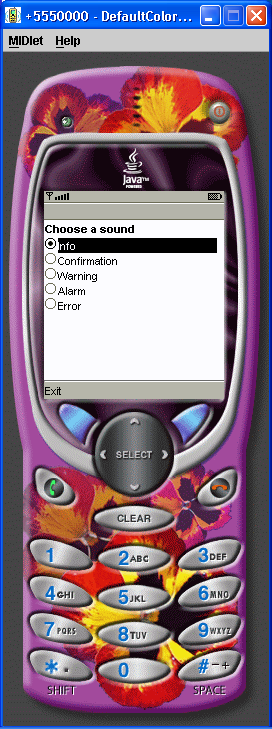
/*--------------------------------------------------
* SoundAlert.java
*
* Example from the book:     Core J2ME Technology
* Copyright John W. Muchow   http://www.CoreJ2ME.com
* You may use/modify for any non-commercial purpose
*-------------------------------------------------*/
import javax.microedition.midlet.*;
import javax.microedition.lcdui.*;

public class SoundAlert extends MIDlet implements ItemStateListener, CommandListener
{
  private Display display;      // Reference to display object
  private Form fmMain;         // Main form
  private Command cmExit;      // Command to exit the MIDlet
  private ChoiceGroup cgSound; // Choice group

  public SoundAlert()
  {
    display = Display.getDisplay(this);

    // Create an exclusive (radio) choice group
    cgSound = new ChoiceGroup("Choose a sound", Choice.EXCLUSIVE);

    // Append options, with no associated images
    cgSound.append("Info", null);
    cgSound.append("Confirmation", null);
    cgSound.append("Warning", null);
    cgSound.append("Alarm", null);
    cgSound.append("Error", null);

    cmExit = new Command("Exit", Command.EXIT, 1);

    // Create Form, add components, listen for events
    fmMain = new Form("");
    fmMain.append(cgSound);
    fmMain.addCommand(cmExit);
    fmMain.setCommandListener(this);
    fmMain.setItemStateListener(this);
  }

  public void startApp()
  {
    display.setCurrent(fmMain);
  }

  public void pauseApp()
  { }

  public void destroyApp(boolean unconditional)
  { }

  public void commandAction(Command c, Displayable s)
  {
    if (c == cmExit)
    {
      destroyApp(false);
      notifyDestroyed();
    }
  }

  public void itemStateChanged(Item item)
  {
    switch (cgSound.getSelectedIndex())
    {
      case 0:
        AlertType.INFO.playSound(display);
        break;

      case 1:
        AlertType.CONFIRMATION.playSound(display);
        break;

      case 2:
        AlertType.WARNING.playSound(display);
        break;

      case 3:
        AlertType.ALARM.playSound(display);
        break;

      case 4:
        AlertType.ERROR.playSound(display);
        break;
    }
  }
}
Thank with us