Source Code : Find directories
Java Is Open Source Programming Language You Can Download From Java and Java Libraries From http://www.oracle.com.
Click Here to download
We provide this code related to title for you to solve your developing problem easily. Libraries which is import in this program you can download from http://www.oracle.com.
Click Here or search from google with Libraries Name you get jar file related it
Find directories
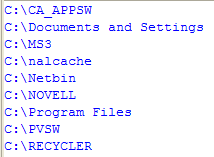
/*
   This program is a part of the companion code for Core Java 8th ed.
   (http://horstmann.com/corejava)

   This program is free software: you can redistribute it and/or modify
   it under the terms of the GNU General Public License as published by
   the Free Software Foundation, either version 3 of the License, or
   (at your option) any later version.

   This program is distributed in the hope that it will be useful,
   but WITHOUT ANY WARRANTY; without even the implied warranty of
   MERCHANTABILITY or FITNESS FOR A PARTICULAR PURPOSE.  See the
   GNU General Public License for more details.

   You should have received a copy of the GNU General Public License
   along with this program.  If not, see <http://www.gnu.org/licenses/>.
*/

import java.io.File;
import java.io.IOException;

/**
 * @version 1.00 05 Sep 1997
 * @author Gary Cornell
 */
public class FindDirectories
{
   public static void main(String[] args)
   {
      // if no arguments provided, start at the parent directory
      if (args.length == 0) args = new String[] { ".." };

      try
      {
         File pathName = new File(args[0]);
         String[] fileNames = pathName.list();

         // enumerate all files in the directory
         for (int i = 0; i < fileNames.length; i++)
         {
            File f = new File(pathName.getPath(), fileNames[i]);

            // if the file is again a directory, call the main method recursively
            if (f.isDirectory())
            {
               System.out.println(f.getCanonicalPath());
               main(new String[] { f.getPath() });
            }
         }
      }
      catch (IOException e)
      {
         e.printStackTrace();
      }
   }
}
Thank with us