Source Code : Java log: Log and Window(JFrame, frame)
Java Is Open Source Programming Language You Can Download From Java and Java Libraries From http://www.oracle.com.
Click Here to download
We provide this code related to title for you to solve your developing problem easily. Libraries which is import in this program you can download from http://www.oracle.com.
Click Here or search from google with Libraries Name you get jar file related it
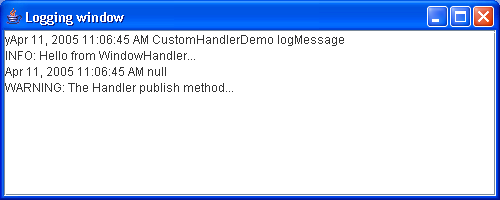
Java log: Log and Window(JFrame, frame)
/*
Logging In Java with the JDK 1.4 Logging API and Apache log4j
by Samudra Gupta
Apress Copyright 2003
ISBN:1590590996

*/

import java.util.logging.*;
import javax.swing.JFrame;
import javax.swing.JTextArea;
import javax.swing.JScrollPane;

class LogWindow extends JFrame {
  private int width;

  private int height;

  private JTextArea textArea = null;

  private JScrollPane pane = null;

  public LogWindow(String title, int width, int height) {
    super(title);
    setSize(width, height);
    textArea = new JTextArea();
    pane = new JScrollPane(textArea);
    getContentPane().add(pane);
    setVisible(true);
  }

  /**
   * This method appends the data to the text area.
   *
   * @param data
   *            the Logging information data
   */
  public void showInfo(String data) {
    textArea.append(data);
    this.getContentPane().validate();
  }
}

class WindowHandler extends Handler {
  //the window to which the logging is done
  private LogWindow window = null;

  private Formatter formatter = null;

  private Level level = null;

  //the singleton instance
  private static WindowHandler handler = null;

  /**
   * private constructor, preventing initialization
   */
  private WindowHandler() {
    configure();
    if (window == null)
      window = new LogWindow("Logging window", 500, 200);
  }

  /**
   * The getInstance method returns the singleton instance of the
   * WindowHandler object It is synchronized to prevent two threads trying to
   * create an instance simultaneously. @ return WindowHandler object
   */

  public static synchronized WindowHandler getInstance() {

    if (handler == null) {
      handler = new WindowHandler();
    }
    return handler;
  }

  /**
   * This method loads the configuration properties from the JDK level
   * configuration file with the help of the LogManager class. It then sets
   * its level, filter and formatter properties.
   */
  private void configure() {
    LogManager manager = LogManager.getLogManager();
    String className = this.getClass().getName();
    String level = manager.getProperty(className + ".level");
    String filter = manager.getProperty(className + ".filter");
    String formatter = manager.getProperty(className + ".formatter");

    //accessing super class methods to set the parameters
    setLevel(level != null ? Level.parse(level) : Level.INFO);
    setFilter(makeFilter(filter));
    setFormatter(makeFormatter(formatter));

  }

  /**
   * private method constructing a Filter object with the filter name.
   *
   * @param filterName
   *            the name of the filter
   * @return the Filter object
   */
  private Filter makeFilter(String filterName) {
    Class c = null;
    Filter f = null;
    try {
      c = Class.forName(filterName);
      f = (Filter) c.newInstance();
    } catch (Exception e) {
      System.out.println("There was a problem to load the filter class: "
          + filterName);
    }
    return f;
  }

  /**
   * private method creating a Formatter object with the formatter name. If no
   * name is specified, it returns a SimpleFormatter object
   *
   * @param formatterName
   *            the name of the formatter
   * @return Formatter object
   */
  private Formatter makeFormatter(String formatterName) {
    Class c = null;
    Formatter f = null;

    try {
      c = Class.forName(formatterName);
      f = (Formatter) c.newInstance();
    } catch (Exception e) {
      f = new SimpleFormatter();
    }
    return f;
  }

  /**
   * This is the overridden publish method of the abstract super class
   * Handler. This method writes the logging information to the associated
   * Java window. This method is synchronized to make it thread-safe. In case
   * there is a problem, it reports the problem with the ErrorManager, only
   * once and silently ignores the others.
   *
   * @record the LogRecord object
   *
   */
  public synchronized void publish(LogRecord record) {
    String message = null;
    //check if the record is loggable
    if (!isLoggable(record))
      return;
    try {
      message = getFormatter().format(record);
    } catch (Exception e) {
      reportError(null, e, ErrorManager.FORMAT_FAILURE);
    }

    try {
      window.showInfo(message);
    } catch (Exception ex) {
      reportError(null, ex, ErrorManager.WRITE_FAILURE);
    }

  }

  public void close() {
  }

  public void flush() {
  }
}

public class CustomHandlerDemo {
  private WindowHandler handler = null;

  private Logger logger = null;

  public CustomHandlerDemo() {
    handler = WindowHandler.getInstance();
    //obtaining a logger instance and setting the handler
    logger = Logger.getLogger("sam.logging.handler");
    logger.addHandler(handler);
  }

  /**
   * This method publishes the log message
   */
  public void logMessage() {
    logger.info("Hello from WindowHandler...");
  }

  public static void main(String args[]) {
    //logging with the help of a logger
    CustomHandlerDemo demo = new CustomHandlerDemo();
    demo.logMessage();
    //using the handler.publish() to log
    WindowHandler h = WindowHandler.getInstance();
    LogRecord r = new LogRecord(Level.WARNING,
        "The Handler publish method...");
    h.publish(r);
  }
}
Thank with us