Java Is Open Source Programming Language You Can Download From Java and Java Libraries From http://www.oracle.com.
We provide this code related to title for you to solve your developing problem easily. Libraries which is import in this program you can download from http://www.oracle.com.
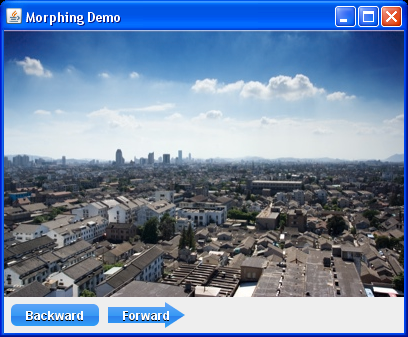
Morphing Demo
/*
* Copyright (c) 2007, Romain Guy
* All rights reserved.
*
* Redistribution and use in source and binary forms, with or without
* modification, are permitted provided that the following conditions
* are met:
*
* * Redistributions of source code must retain the above copyright
* notice, this list of conditions and the following disclaimer.
* * Redistributions in binary form must reproduce the above
* copyright notice, this list of conditions and the following
* disclaimer in the documentation and/or other materials provided
* with the distribution.
* * Neither the name of the TimingFramework project nor the names of its
* contributors may be used to endorse or promote products derived
* from this software without specific prior written permission.
*
* THIS SOFTWARE IS PROVIDED BY THE COPYRIGHT HOLDERS AND CONTRIBUTORS
* "AS IS" AND ANY EXPRESS OR IMPLIED WARRANTIES, INCLUDING, BUT NOT
* LIMITED TO, THE IMPLIED WARRANTIES OF MERCHANTABILITY AND FITNESS FOR
* A PARTICULAR PURPOSE ARE DISCLAIMED. IN NO EVENT SHALL THE COPYRIGHT
* OWNER OR CONTRIBUTORS BE LIABLE FOR ANY DIRECT, INDIRECT, INCIDENTAL,
* SPECIAL, EXEMPLARY, OR CONSEQUENTIAL DAMAGES (INCLUDING, BUT NOT
* LIMITED TO, PROCUREMENT OF SUBSTITUTE GOODS OR SERVICES; LOSS OF USE,
* DATA, OR PROFITS; OR BUSINESS INTERRUPTION) HOWEVER CAUSED AND ON ANY
* THEORY OF LIABILITY, WHETHER IN CONTRACT, STRICT LIABILITY, OR TORT
* (INCLUDING NEGLIGENCE OR OTHERWISE) ARISING IN ANY WAY OUT OF THE USE
* OF THIS SOFTWARE, EVEN IF ADVISED OF THE POSSIBILITY OF SUCH DAMAGE.
*/
import java.awt.image.BufferedImage;
import java.awt.image.ColorModel;
import java.awt.image.Raster;
import java.awt.image.WritableRaster;
import java.awt.GraphicsConfiguration;
import java.awt.Transparency;
import java.awt.Graphics;
import java.awt.GraphicsEnvironment;
import java.awt.Graphics2D;
import java.awt.RenderingHints;
import java.io.IOException;
import java.net.URL;
import javax.imageio.ImageIO;
import java.awt.Rectangle;
import java.awt.Shape;
import java.awt.geom.AffineTransform;
import java.awt.geom.FlatteningPathIterator;
import java.awt.geom.IllegalPathStateException;
import java.awt.geom.PathIterator;
import java.awt.geom.Point2D;
import java.awt.geom.Rectangle2D;
import java.awt.image.BufferedImage;
import java.awt.image.ColorModel;
import java.awt.image.Raster;
import java.awt.image.WritableRaster;
import java.awt.GraphicsConfiguration;
import java.awt.Transparency;
import java.awt.Graphics;
import java.awt.GraphicsEnvironment;
import java.awt.Graphics2D;
import java.awt.RenderingHints;
import java.io.IOException;
import java.net.URL;
import javax.imageio.ImageIO;
import java.awt.AlphaComposite;
import java.awt.BorderLayout;
import java.awt.Color;
import java.awt.Dimension;
import java.awt.FlowLayout;
import java.awt.Font;
import java.awt.Graphics;
import java.awt.Graphics2D;
import java.awt.LinearGradientPaint;
import java.awt.RenderingHints;
import java.awt.Shape;
import java.awt.Toolkit;
import java.awt.event.ActionEvent;
import java.awt.event.ActionListener;
import java.awt.geom.GeneralPath;
import java.awt.geom.RoundRectangle2D;
import java.awt.image.BufferedImage;
import java.io.IOException;
import java.util.Map;
import javax.swing.JButton;
import javax.swing.JComponent;
import javax.swing.JFrame;
import javax.swing.JPanel;
import javax.swing.SwingUtilities;
import org.jdesktop.animation.timing.Animator;
import org.jdesktop.animation.timing.interpolation.PropertySetter;
import org.jdesktop.animation.timing.triggers.MouseTrigger;
import org.jdesktop.animation.timing.triggers.MouseTriggerEvent;
/**
*
* @author Romain Guy <romain.guy@mac.com>
*/
public class MorphingDemo extends JFrame {
private ImageViewer imageViewer;
public MorphingDemo() {
super("Morphing Demo");
add(buildImageViewer());
add(buildControls(), BorderLayout.SOUTH);
pack();
setDefaultCloseOperation(EXIT_ON_CLOSE);
setLocationRelativeTo(null);
}
private JComponent buildImageViewer() {
return imageViewer = new ImageViewer();
}
private JComponent buildControls() {
JPanel panel = new JPanel(new FlowLayout(FlowLayout.LEADING));
JButton button;
panel.add(button = new DirectionButton("Backward",
DirectionButton.Direction.LEFT));
button.addActionListener(new ActionListener() {
public void actionPerformed(ActionEvent e) {
imageViewer.previous();
}
});
panel.add(button = new DirectionButton("Forward",
DirectionButton.Direction.RIGHT));
button.addActionListener(new ActionListener() {
public void actionPerformed(ActionEvent e) {
imageViewer.next();
}
});
return panel;
}
public static class DirectionButton extends JButton {
public enum Direction {
LEFT,
RIGHT
};
private DirectionButton.Direction direction;
private Map desktopHints;
private float morphing = 0.0f;
private DirectionButton(String text, Direction direction) {
super(text);
this.direction = direction;
setupTriggers();
setFont(getFont().deriveFont(Font.BOLD));
setOpaque(false);
setBorderPainted(false);
setContentAreaFilled(false);
setFocusPainted(false);
}
private void setupTriggers() {
Animator animator = PropertySetter.createAnimator(
150, this, "morphing", 0.0f, 1.0f);
animator.setAcceleration(0.2f);
animator.setDeceleration(0.3f);
MouseTrigger.addTrigger(this, animator, MouseTriggerEvent.ENTER, true);
}
private Morphing2D createMorph() {
Shape sourceShape = new RoundRectangle2D.Double(2.0, 2.0,
getWidth() - 4.0, getHeight() - 4.0, 12.0, 12.0);
GeneralPath.Double destinationShape = new GeneralPath.Double();
destinationShape.moveTo(2.0, getHeight() / 2.0);
destinationShape.lineTo(22.0, 0.0);
destinationShape.lineTo(22.0, 5.0);
destinationShape.lineTo(getWidth() - 2.0, 5.0);
destinationShape.lineTo(getWidth() - 2.0, getHeight() - 5.0);
destinationShape.lineTo(22.0, getHeight() - 5.0);
destinationShape.lineTo(22.0, getHeight());
destinationShape.closePath();
return new Morphing2D(sourceShape, destinationShape);
}
public float getMorphing() {
return morphing;
}
public void setMorphing(float morphing) {
this.morphing = morphing;
repaint();
}
@Override
protected void paintComponent(Graphics g) {
Graphics2D g2 = (Graphics2D) g.create();
g2.setRenderingHint(RenderingHints.KEY_ANTIALIASING,
RenderingHints.VALUE_ANTIALIAS_ON);
if (desktopHints == null) {
Toolkit tk = Toolkit.getDefaultToolkit();
desktopHints = (Map) (tk.getDesktopProperty("awt.font.desktophints"));
}
if (desktopHints != null) {
g2.addRenderingHints(desktopHints);
}
LinearGradientPaint p;
Color[] colors;
if (!getModel().isArmed()) {
colors = new Color[] {
new Color(0x63a5f7),
new Color(0x3799f4),
new Color(0x2d7eeb),
new Color(0x30a5f9) };
} else {
colors = new Color[] {
new Color(0x63a5f7).darker(),
new Color(0x3799f4).darker(),
new Color(0x2d7eeb).darker(),
new Color(0x30a5f9).darker() };
}
p = new LinearGradientPaint(0.0f, 0.0f, 0.0f, getHeight(),
new float[] { 0.0f, 0.5f, 0.501f, 1.0f },
colors);
g2.setPaint(p);
Morphing2D morph = createMorph();
morph.setMorphing(getMorphing());
if (direction == Direction.RIGHT) {
g2.translate(getWidth(), 0.0);
g2.scale(-1.0, 1.0);
}
g2.fill(morph);
if (direction == Direction.RIGHT) {
g2.scale(-1.0, 1.0);
g2.translate(-getWidth(), 0.0);
}
int width = g2.getFontMetrics().stringWidth(getText());
int x = (getWidth() - width) / 2;
int y = getHeight() / 2 + g2.getFontMetrics().getAscent() / 2 - 1;
g2.setColor(Color.BLACK);
g2.drawString(getText(), x, y + 1);
g2.setColor(Color.WHITE);
g2.drawString(getText(), x, y);
}
}
public static class ImageViewer extends JComponent {
private BufferedImage firstImage;
private BufferedImage secondImage;
private float alpha = 0.0f;
private ImageViewer() {
try {
firstImage = GraphicsUtilities.loadCompatibleImage(
getClass().getResource("suzhou.jpg"));
secondImage = GraphicsUtilities.loadCompatibleImage(
getClass().getResource("shanghai.jpg"));
} catch (IOException ex) {
ex.printStackTrace();
}
}
@Override
public Dimension getPreferredSize() {
return new Dimension(firstImage.getWidth(), firstImage.getHeight());
}
public void next() {
Animator animator = new Animator(500);
animator.addTarget(new PropertySetter(this, "alpha", 1.0f));
animator.setAcceleration(0.2f);
animator.setDeceleration(0.4f);
animator.start();
}
public void previous() {
Animator animator = new Animator(500);
animator.addTarget(new PropertySetter(this, "alpha", 0.0f));
animator.setAcceleration(0.2f);
animator.setDeceleration(0.4f);
animator.start();
}
public void setAlpha(float alpha) {
this.alpha = alpha;
repaint();
}
public float getAlpha() {
return this.alpha;
}
@Override
protected void paintComponent(Graphics g) {
Graphics2D g2 = (Graphics2D) g.create();
g2.setComposite(AlphaComposite.SrcOver.derive(1.0f - alpha));
g2.drawImage(firstImage, 0, 0, null);
g2.setComposite(AlphaComposite.SrcOver.derive(alpha));
g2.drawImage(secondImage, 0, 0, null);
}
}
public static void main(String[] args) {
SwingUtilities.invokeLater(new Runnable() {
public void run() {
new MorphingDemo().setVisible(true);
}
});
}
}
/*
* $Id: Morphing2D.java,v 1.1 2007/01/26 17:35:35 gfx Exp $
*
* Copyright 2006 Sun Microsystems, Inc., 4150 Network Circle,
* Santa Clara, California 95054, U.S.A. All rights reserved.
*
* Licensed under LGPL.
*/
/**
* <p>A morphing shape is a shape which geometry is constructed from two
* other shapes: a start shape and an end shape.</p>
* <p>The morphing property of a morphing shape defines the amount of
* transformation applied to the start shape to turn it into the end shape.</p>
* <p>Both shapes must have the same winding rule.</p>
*
* @author Jim Graham
* @author Romain Guy <romain.guy@mac.com> (Maintainer)
*/
class Morphing2D implements Shape {
private double morph;
private Geometry startGeometry;
private Geometry endGeometry;
/**
* <p>Creates a new morphing shape. A morphing shape can be used to turn
* one shape into another one. The transformation can be controlled by the
* morph property.</p>
*
* @param startShape the shape to morph from
* @param endShape the shape to morph to
*
* @throws IllegalPathStateException if the shapes do not have the same
* winding rule
* @see #getMorphing()
* @see #setMorphing(double)
*/
public Morphing2D(Shape startShape, Shape endShape) {
startGeometry = new Geometry(startShape);
endGeometry = new Geometry(endShape);
if (startGeometry.getWindingRule() != endGeometry.getWindingRule()) {
throw new IllegalPathStateException("shapes must use same " +
"winding rule");
}
double tvals0[] = startGeometry.getTvals();
double tvals1[] = endGeometry.getTvals();
double masterTvals[] = mergeTvals(tvals0, tvals1);
startGeometry.setTvals(masterTvals);
endGeometry.setTvals(masterTvals);
}
/**
* <p>Returns the morphing value between the two shapes.</p>
*
* @return the morphing value between the two shapes
*
* @see #setMorphing(double)
*/
public double getMorphing() {
return morph;
}
/**
* <p>Sets the morphing value between the two shapes. This value controls
* the transformation from the start shape to the end shape. A value of 0.0
* is the start shap. A value of 1.0 is the end shape. A value of 0.5 is a
* new shape, morphed half way from the start shape to the end shape.</p>
* <p>The specified value should be between 0.0 and 1.0. If not, the value
* is clamped in the appropriate range.</p>
*
* @param morph the morphing value between the two shapes
*
* @see #getMorphing()
*/
public void setMorphing(double morph) {
if (morph > 1) {
morph = 1;
} else if (morph >= 0) {
// morphing is finite, not NaN, and in range
} else {
// morph is < 0 or NaN
morph = 0;
}
this.morph = morph;
}
private static double interp(double v0, double v1, double t) {
return (v0 + ((v1 - v0) * t));
}
private static double[] mergeTvals(double tvals0[], double tvals1[]) {
int i0 = 0;
int i1 = 0;
int numtvals = 0;
while (i0 < tvals0.length && i1 < tvals1.length) {
double t0 = tvals0[i0];
double t1 = tvals1[i1];
if (t0 <= t1) {
i0++;
}
if (t1 <= t0) {
i1++;
}
numtvals++;
}
double newtvals[] = new double[numtvals];
i0 = 0;
i1 = 0;
numtvals = 0;
while (i0 < tvals0.length && i1 < tvals1.length) {
double t0 = tvals0[i0];
double t1 = tvals1[i1];
if (t0 <= t1) {
newtvals[numtvals] = t0;
i0++;
}
if (t1 <= t0) {
newtvals[numtvals] = t1;
i1++;
}
numtvals++;
}
return newtvals;
}
/**
* @{inheritDoc}
*/
public Rectangle getBounds() {
return getBounds2D().getBounds();
}
/**
* @{inheritDoc}
*/
public Rectangle2D getBounds2D() {
int n = startGeometry.getNumCoords();
double xmin, ymin, xmax, ymax;
xmin = xmax = interp(startGeometry.getCoord(0), endGeometry.getCoord(0),
morph);
ymin = ymax = interp(startGeometry.getCoord(1), endGeometry.getCoord(1),
morph);
for (int i = 2; i < n; i += 2) {
double x = interp(startGeometry.getCoord(i),
endGeometry.getCoord(i), morph);
double y = interp(startGeometry.getCoord(i + 1),
endGeometry.getCoord(i + 1), morph);
if (xmin > x) {
xmin = x;
}
if (ymin > y) {
ymin = y;
}
if (xmax < x) {
xmax = x;
}
if (ymax < y) {
ymax = y;
}
}
return new Rectangle2D.Double(xmin, ymin, xmax - xmin, ymax - ymin);
}
/**
* @{inheritDoc}
*/
public boolean contains(double x, double y) {
throw new InternalError("unimplemented");
}
/**
* @{inheritDoc}
*/
public boolean contains(Point2D p) {
return contains(p.getX(), p.getY());
}
/**
* @{inheritDoc}
*/
public boolean intersects(double x, double y, double w, double h) {
throw new InternalError("unimplemented");
}
/**
* @{inheritDoc}
*/
public boolean intersects(Rectangle2D r) {
return intersects(r.getX(), r.getY(), r.getWidth(), r.getHeight());
}
/**
* @{inheritDoc}
*/
public boolean contains(double x, double y, double w, double h) {
throw new InternalError("unimplemented");
}
/**
* @{inheritDoc}
*/
public boolean contains(Rectangle2D r) {
return contains(r.getX(), r.getY(), r.getWidth(), r.getHeight());
}
/**
* @{inheritDoc}
*/
public PathIterator getPathIterator(AffineTransform at) {
return new Iterator(at, startGeometry, endGeometry, morph);
}
/**
* @{inheritDoc}
*/
public PathIterator getPathIterator(AffineTransform at, double flatness) {
return new FlatteningPathIterator(getPathIterator(at), flatness);
}
private static class Geometry {
static final double THIRD = (1.0 / 3.0);
static final double MIN_LEN = 0.001;
double bezierCoords[];
int numCoords;
int windingrule;
double myTvals[];
public Geometry(Shape s) {
// Multiple of 6 plus 2 more for initial moveto
bezierCoords = new double[20];
PathIterator pi = s.getPathIterator(null);
windingrule = pi.getWindingRule();
if (pi.isDone()) {
// We will have 1 segment and it will be all zeros
// It will have 8 coordinates (2 for moveto, 6 for cubic)
numCoords = 8;
}
double coords[] = new double[6];
int type = pi.currentSegment(coords);
pi.next();
if (type != PathIterator.SEG_MOVETO) {
throw new IllegalPathStateException("missing initial moveto");
}
double curx = bezierCoords[0] = coords[0];
double cury = bezierCoords[1] = coords[1];
double newx, newy;
numCoords = 2;
while (!pi.isDone()) {
if (numCoords + 6 > bezierCoords.length) {
// Keep array size to a multiple of 6 plus 2
int newsize = (numCoords - 2) * 2 + 2;
double newCoords[] = new double[newsize];
System.arraycopy(bezierCoords, 0, newCoords, 0, numCoords);
bezierCoords = newCoords;
}
switch (pi.currentSegment(coords)) {
case PathIterator.SEG_MOVETO:
throw new InternalError(
"Cannot handle multiple subpaths");
case PathIterator.SEG_CLOSE:
if (curx == bezierCoords[0] && cury == bezierCoords[1])
{
break;
}
coords[0] = bezierCoords[0];
coords[1] = bezierCoords[1];
/* NO BREAK */
case PathIterator.SEG_LINETO:
newx = coords[0];
newy = coords[1];
// A third of the way from curxy to newxy:
bezierCoords[numCoords++] = interp(curx, newx, THIRD);
bezierCoords[numCoords++] = interp(cury, newy, THIRD);
// A third of the way from newxy back to curxy:
bezierCoords[numCoords++] = interp(newx, curx, THIRD);
bezierCoords[numCoords++] = interp(newy, cury, THIRD);
bezierCoords[numCoords++] = curx = newx;
bezierCoords[numCoords++] = cury = newy;
break;
case PathIterator.SEG_QUADTO:
double ctrlx = coords[0];
double ctrly = coords[1];
newx = coords[2];
newy = coords[3];
// A third of the way from ctrlxy back to curxy:
bezierCoords[numCoords++] = interp(ctrlx, curx, THIRD);
bezierCoords[numCoords++] = interp(ctrly, cury, THIRD);
// A third of the way from ctrlxy to newxy:
bezierCoords[numCoords++] = interp(ctrlx, newx, THIRD);
bezierCoords[numCoords++] = interp(ctrly, newy, THIRD);
bezierCoords[numCoords++] = curx = newx;
bezierCoords[numCoords++] = cury = newy;
break;
case PathIterator.SEG_CUBICTO:
bezierCoords[numCoords++] = coords[0];
bezierCoords[numCoords++] = coords[1];
bezierCoords[numCoords++] = coords[2];
bezierCoords[numCoords++] = coords[3];
bezierCoords[numCoords++] = curx = coords[4];
bezierCoords[numCoords++] = cury = coords[5];
break;
}
pi.next();
}
// Add closing segment if either:
// - we only have initial moveto - expand it to an empty cubic
// - or we are not back to the starting point
if ((numCoords < 8) ||
curx != bezierCoords[0] ||
cury != bezierCoords[1]) {
newx = bezierCoords[0];
newy = bezierCoords[1];
// A third of the way from curxy to newxy:
bezierCoords[numCoords++] = interp(curx, newx, THIRD);
bezierCoords[numCoords++] = interp(cury, newy, THIRD);
// A third of the way from newxy back to curxy:
bezierCoords[numCoords++] = interp(newx, curx, THIRD);
bezierCoords[numCoords++] = interp(newy, cury, THIRD);
bezierCoords[numCoords++] = newx;
bezierCoords[numCoords++] = newy;
}
// Now find the segment endpoint with the smallest Y coordinate
int minPt = 0;
double minX = bezierCoords[0];
double minY = bezierCoords[1];
for (int ci = 6; ci < numCoords; ci += 6) {
double x = bezierCoords[ci];
double y = bezierCoords[ci + 1];
if (y < minY || (y == minY && x < minX)) {
minPt = ci;
minX = x;
minY = y;
}
}
// If the smallest Y coordinate is not the first coordinate,
// rotate the points so that it is...
if (minPt > 0) {
// Keep in mind that first 2 coords == last 2 coords
double newCoords[] = new double[numCoords];
// Copy all coordinates from minPt to the end of the
// array to the beginning of the new array
System.arraycopy(bezierCoords, minPt,
newCoords, 0,
numCoords - minPt);
// Now we do not want to copy 0,1 as they are duplicates
// of the last 2 coordinates which we just copied. So
// we start the source copy at index 2, but we still
// copy a full minPt coordinates which copies the two
// coordinates that were at minPt to the last two elements
// of the array, thus ensuring that thew new array starts
// and ends with the same pair of coordinates...
System.arraycopy(bezierCoords, 2,
newCoords, numCoords - minPt,
minPt);
bezierCoords = newCoords;
}
/* Clockwise enforcement:
* - This technique is based on the formula for calculating
* the area of a Polygon. The standard formula is:
* Area(Poly) = 1/2 * sum(x[i]*y[i+1] - x[i+1]y[i])
* - The returned area is negative if the polygon is
* "mostly clockwise" and positive if the polygon is
* "mostly counter-clockwise".
* - One failure mode of the Area calculation is if the
* Polygon is self-intersecting. This is due to the
* fact that the areas on each side of the self-intersection
* are bounded by segments which have opposite winding
* direction. Thus, those areas will have opposite signs
* on the acccumulation of their area summations and end
* up canceling each other out partially.
* - This failure mode of the algorithm in determining the
* exact magnitude of the area is not actually a big problem
* for our needs here since we are only using the sign of
* the resulting area to figure out the overall winding
* direction of the path. If self-intersections cause
* different parts of the path to disagree as to the
* local winding direction, that is no matter as we just
* wait for the final answer to tell us which winding
* direction had greater representation. If the final
* result is zero then the path was equal parts clockwise
* and counter-clockwise and we do not care about which
* way we order it as either way will require half of the
* path to unwind and re-wind itself.
*/
double area = 0;
// Note that first and last points are the same so we
// do not need to process coords[0,1] against coords[n-2,n-1]
curx = bezierCoords[0];
cury = bezierCoords[1];
for (int i = 2; i < numCoords; i += 2) {
newx = bezierCoords[i];
newy = bezierCoords[i + 1];
area += curx * newy - newx * cury;
curx = newx;
cury = newy;
}
if (area < 0) {
/* The area is negative so the shape was clockwise
* in a Euclidean sense. But, our screen coordinate
* systems have the origin in the upper left so they
* are flipped. Thus, this path "looks" ccw on the
* screen so we are flipping it to "look" clockwise.
* Note that the first and last points are the same
* so we do not need to swap them.
* (Not that it matters whether the paths end up cw
* or ccw in the end as long as all of them are the
* same, but above we called this section "Clockwise
* Enforcement", so we do not want to be liars. ;-)
*/
// Note that [0,1] do not need to be swapped with [n-2,n-1]
// So first pair to swap is [2,3] and [n-4,n-3]
int i = 2;
int j = numCoords - 4;
while (i < j) {
curx = bezierCoords[i];
cury = bezierCoords[i + 1];
bezierCoords[i] = bezierCoords[j];
bezierCoords[i + 1] = bezierCoords[j + 1];
bezierCoords[j] = curx;
bezierCoords[j + 1] = cury;
i += 2;
j -= 2;
}
}
}
public int getWindingRule() {
return windingrule;
}
public int getNumCoords() {
return numCoords;
}
public double getCoord(int i) {
return bezierCoords[i];
}
public double[] getTvals() {
if (myTvals != null) {
return myTvals;
}
// assert(numCoords >= 8);
// assert(((numCoords - 2) % 6) == 0);
double tvals[] = new double[(numCoords - 2) / 6 + 1];
// First calculate total "length" of path
// Length of each segment is averaged between
// the length between the endpoints (a lower bound for a cubic)
// and the length of the control polygon (an upper bound)
double segx = bezierCoords[0];
double segy = bezierCoords[1];
double tlen = 0;
int ci = 2;
int ti = 0;
while (ci < numCoords) {
double prevx, prevy, newx, newy;
prevx = segx;
prevy = segy;
newx = bezierCoords[ci++];
newy = bezierCoords[ci++];
prevx -= newx;
prevy -= newy;
double len = Math.sqrt(prevx * prevx + prevy * prevy);
prevx = newx;
prevy = newy;
newx = bezierCoords[ci++];
newy = bezierCoords[ci++];
prevx -= newx;
prevy -= newy;
len += Math.sqrt(prevx * prevx + prevy * prevy);
prevx = newx;
prevy = newy;
newx = bezierCoords[ci++];
newy = bezierCoords[ci++];
prevx -= newx;
prevy -= newy;
len += Math.sqrt(prevx * prevx + prevy * prevy);
// len is now the total length of the control polygon
segx -= newx;
segy -= newy;
len += Math.sqrt(segx * segx + segy * segy);
// len is now sum of linear length and control polygon length
len /= 2;
// len is now average of the two lengths
/* If the result is zero length then we will have problems
* below trying to do the math and bookkeeping to split
* the segment or pair it against the segments in the
* other shape. Since these lengths are just estimates
* to map the segments of the two shapes onto corresponding
* segments of "approximately the same length", we will
* simply fudge the length of this segment to be at least
* a minimum value and it will simply grow from zero or
* near zero length to a non-trivial size as it morphs.
*/
if (len < MIN_LEN) {
len = MIN_LEN;
}
tlen += len;
tvals[ti++] = tlen;
segx = newx;
segy = newy;
}
// Now set tvals for each segment to its proportional
// part of the length
double prevt = tvals[0];
tvals[0] = 0;
for (ti = 1; ti < tvals.length - 1; ti++) {
double nextt = tvals[ti];
tvals[ti] = prevt / tlen;
prevt = nextt;
}
tvals[ti] = 1;
return (myTvals = tvals);
}
public void setTvals(double newTvals[]) {
double oldCoords[] = bezierCoords;
double newCoords[] = new double[2 + (newTvals.length - 1) * 6];
double oldTvals[] = getTvals();
int oldci = 0;
double x0, xc0, xc1, x1;
double y0, yc0, yc1, y1;
x0 = xc0 = xc1 = x1 = oldCoords[oldci++];
y0 = yc0 = yc1 = y1 = oldCoords[oldci++];
int newci = 0;
newCoords[newci++] = x0;
newCoords[newci++] = y0;
double t0 = 0;
double t1 = 0;
int oldti = 1;
int newti = 1;
while (newti < newTvals.length) {
if (t0 >= t1) {
x0 = x1;
y0 = y1;
xc0 = oldCoords[oldci++];
yc0 = oldCoords[oldci++];
xc1 = oldCoords[oldci++];
yc1 = oldCoords[oldci++];
x1 = oldCoords[oldci++];
y1 = oldCoords[oldci++];
t1 = oldTvals[oldti++];
}
double nt = newTvals[newti++];
// assert(nt > t0);
if (nt < t1) {
// Make nt proportional to [t0 => t1] range
double relt = (nt - t0) / (t1 - t0);
newCoords[newci++] = x0 = interp(x0, xc0, relt);
newCoords[newci++] = y0 = interp(y0, yc0, relt);
xc0 = interp(xc0, xc1, relt);
yc0 = interp(yc0, yc1, relt);
xc1 = interp(xc1, x1, relt);
yc1 = interp(yc1, y1, relt);
newCoords[newci++] = x0 = interp(x0, xc0, relt);
newCoords[newci++] = y0 = interp(y0, yc0, relt);
xc0 = interp(xc0, xc1, relt);
yc0 = interp(yc0, yc1, relt);
newCoords[newci++] = x0 = interp(x0, xc0, relt);
newCoords[newci++] = y0 = interp(y0, yc0, relt);
} else {
newCoords[newci++] = xc0;
newCoords[newci++] = yc0;
newCoords[newci++] = xc1;
newCoords[newci++] = yc1;
newCoords[newci++] = x1;
newCoords[newci++] = y1;
}
t0 = nt;
}
bezierCoords = newCoords;
numCoords = newCoords.length;
myTvals = newTvals;
}
}
private static class Iterator implements PathIterator {
AffineTransform at;
Geometry g0;
Geometry g1;
double t;
int cindex;
public Iterator(AffineTransform at,
Geometry g0, Geometry g1,
double t) {
this.at = at;
this.g0 = g0;
this.g1 = g1;
this.t = t;
}
/**
* @{inheritDoc}
*/
public int getWindingRule() {
return g0.getWindingRule();
}
/**
* @{inheritDoc}
*/
public boolean isDone() {
return (cindex > g0.getNumCoords());
}
/**
* @{inheritDoc}
*/
public void next() {
if (cindex == 0) {
cindex = 2;
} else {
cindex += 6;
}
}
double dcoords[];
/**
* @{inheritDoc}
*/
public int currentSegment(float[] coords) {
if (dcoords == null) {
dcoords = new double[6];
}
int type = currentSegment(dcoords);
if (type != SEG_CLOSE) {
coords[0] = (float) dcoords[0];
coords[1] = (float) dcoords[1];
if (type != SEG_MOVETO) {
coords[2] = (float) dcoords[2];
coords[3] = (float) dcoords[3];
coords[4] = (float) dcoords[4];
coords[5] = (float) dcoords[5];
}
}
return type;
}
/**
* @{inheritDoc}
*/
public int currentSegment(double[] coords) {
int type;
int n;
if (cindex == 0) {
type = SEG_MOVETO;
n = 2;
} else if (cindex >= g0.getNumCoords()) {
type = SEG_CLOSE;
n = 0;
} else {
type = SEG_CUBICTO;
n = 6;
}
if (n > 0) {
for (int i = 0; i < n; i++) {
coords[i] = interp(g0.getCoord(cindex + i),
g1.getCoord(cindex + i),
t);
}
if (at != null) {
at.transform(coords, 0, coords, 0, n / 2);
}
}
return type;
}
}
}
/**
* <p><code>GraphicsUtilities</code> contains a set of tools to perform
* common graphics operations easily. These operations are divided into
* several themes, listed below.</p>
* <h2>Compatible Images</h2>
* <p>Compatible images can, and should, be used to increase drawing
* performance. This class provides a number of methods to load compatible
* images directly from files or to convert existing images to compatibles
* images.</p>
* <h2>Creating Thumbnails</h2>
* <p>This class provides a number of methods to easily scale down images.
* Some of these methods offer a trade-off between speed and result quality and
* shouuld be used all the time. They also offer the advantage of producing
* compatible images, thus automatically resulting into better runtime
* performance.</p>
* <p>All these methodes are both faster than
* {@link java.awt.Image#getScaledInstance(int, int, int)} and produce
* better-looking results than the various <code>drawImage()</code> methods
* in {@link java.awt.Graphics}, which can be used for image scaling.</p>
* <h2>Image Manipulation</h2>
* <p>This class provides two methods to get and set pixels in a buffered image.
* These methods try to avoid unmanaging the image in order to keep good
* performance.</p>
*
* @author Romain Guy <romain.guy@mac.com>
*/
class GraphicsUtilities {
private GraphicsUtilities() {
}
// Returns the graphics configuration for the primary screen
private static GraphicsConfiguration getGraphicsConfiguration() {
return GraphicsEnvironment.getLocalGraphicsEnvironment().
getDefaultScreenDevice().getDefaultConfiguration();
}
/**
* <p>Returns a new <code>BufferedImage</code> using the same color model
* as the image passed as a parameter. The returned image is only compatible
* with the image passed as a parameter. This does not mean the returned
* image is compatible with the hardware.</p>
*
* @param image the reference image from which the color model of the new
* image is obtained
* @return a new <code>BufferedImage</code>, compatible with the color model
* of <code>image</code>
*/
public static BufferedImage createColorModelCompatibleImage(BufferedImage image) {
ColorModel cm = image.getColorModel();
return new BufferedImage(cm,
cm.createCompatibleWritableRaster(image.getWidth(),
image.getHeight()),
cm.isAlphaPremultiplied(), null);
}
/**
* <p>Returns a new compatible image with the same width, height and
* transparency as the image specified as a parameter.</p>
*
* @see java.awt.Transparency
* @see #createCompatibleImage(int, int)
* @see #createCompatibleImage(java.awt.image.BufferedImage, int, int)
* @see #createCompatibleTranslucentImage(int, int)
* @see #loadCompatibleImage(java.net.URL)
* @see #toCompatibleImage(java.awt.image.BufferedImage)
* @param image the reference image from which the dimension and the
* transparency of the new image are obtained
* @return a new compatible <code>BufferedImage</code> with the same
* dimension and transparency as <code>image</code>
*/
public static BufferedImage createCompatibleImage(BufferedImage image) {
return createCompatibleImage(image, image.getWidth(), image.getHeight());
}
/**
* <p>Returns a new compatible image of the specified width and height, and
* the same transparency setting as the image specified as a parameter.</p>
*
* @see java.awt.Transparency
* @see #createCompatibleImage(java.awt.image.BufferedImage)
* @see #createCompatibleImage(int, int)
* @see #createCompatibleTranslucentImage(int, int)
* @see #loadCompatibleImage(java.net.URL)
* @see #toCompatibleImage(java.awt.image.BufferedImage)
* @param width the width of the new image
* @param height the height of the new image
* @param image the reference image from which the transparency of the new
* image is obtained
* @return a new compatible <code>BufferedImage</code> with the same
* transparency as <code>image</code> and the specified dimension
*/
public static BufferedImage createCompatibleImage(BufferedImage image,
int width, int height) {
return getGraphicsConfiguration().createCompatibleImage(width, height,
image.getTransparency());
}
/**
* <p>Returns a new opaque compatible image of the specified width and
* height.</p>
*
* @see #createCompatibleImage(java.awt.image.BufferedImage)
* @see #createCompatibleImage(java.awt.image.BufferedImage, int, int)
* @see #createCompatibleTranslucentImage(int, int)
* @see #loadCompatibleImage(java.net.URL)
* @see #toCompatibleImage(java.awt.image.BufferedImage)
* @param width the width of the new image
* @param height the height of the new image
* @return a new opaque compatible <code>BufferedImage</code> of the
* specified width and height
*/
public static BufferedImage createCompatibleImage(int width, int height) {
return getGraphicsConfiguration().createCompatibleImage(width, height);
}
/**
* <p>Returns a new translucent compatible image of the specified width
* and height.</p>
*
* @see #createCompatibleImage(java.awt.image.BufferedImage)
* @see #createCompatibleImage(java.awt.image.BufferedImage, int, int)
* @see #createCompatibleImage(int, int)
* @see #loadCompatibleImage(java.net.URL)
* @see #toCompatibleImage(java.awt.image.BufferedImage)
* @param width the width of the new image
* @param height the height of the new image
* @return a new translucent compatible <code>BufferedImage</code> of the
* specified width and height
*/
public static BufferedImage createCompatibleTranslucentImage(int width,
int height) {
return getGraphicsConfiguration().createCompatibleImage(width, height,
Transparency.TRANSLUCENT);
}
/**
* <p>Returns a new compatible image from a URL. The image is loaded from the
* specified location and then turned, if necessary into a compatible
* image.</p>
*
* @see #createCompatibleImage(java.awt.image.BufferedImage)
* @see #createCompatibleImage(java.awt.image.BufferedImage, int, int)
* @see #createCompatibleImage(int, int)
* @see #createCompatibleTranslucentImage(int, int)
* @see #toCompatibleImage(java.awt.image.BufferedImage)
* @param resource the URL of the picture to load as a compatible image
* @return a new translucent compatible <code>BufferedImage</code> of the
* specified width and height
* @throws java.io.IOException if the image cannot be read or loaded
*/
public static B