Source Code : Simple pool of Threads
Java Is Open Source Programming Language You Can Download From Java and Java Libraries From http://www.oracle.com.
Click Here to download
We provide this code related to title for you to solve your developing problem easily. Libraries which is import in this program you can download from http://www.oracle.com.
Click Here or search from google with Libraries Name you get jar file related it
Simple pool of Threads
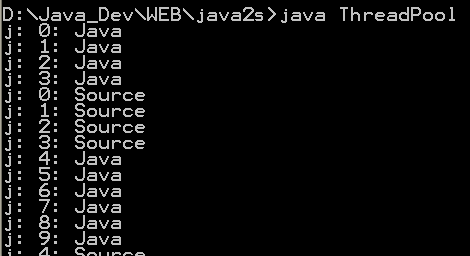
/*
 * Copyright (c) 1998 - 2005 Versant Corporation
 * All rights reserved. This program and the accompanying materials
 * are made available under the terms of the Eclipse Public License v1.0
 * which accompanies this distribution, and is available at
 * http://www.eclipse.org/legal/epl-v10.html
 *
 * Contributors:
 * Versant Corporation - initial API and implementation
 */

import java.util.LinkedList;
import java.util.Iterator;
import java.util.HashSet;

/**
 * Simple pool of Threads.
 */
public class ThreadPool {

    private String name;
    private HashSet active = new HashSet();
    private LinkedList idle = new LinkedList();
    private int idleCount;
    private int maxActive = 10;
    private int maxIdle = 3;
    private int lastThreadId;
    private boolean closed;

    public ThreadPool(String name) {
        this.name = name;
    }

    public int getMaxActive() {
        return maxActive;
    }

    public void setMaxActive(int maxActive) {
        this.maxActive = maxActive;
    }

    public int getMaxIdle() {
        return maxIdle;
    }

    public void setMaxIdle(int maxIdle) {
        this.maxIdle = maxIdle;
    }

    public synchronized int getActiveCount() {
        return active.size();
    }

    public synchronized int getIdleCount() {
        return idleCount;
    }

    /**
     * Close the pool, stopping all threads. This does not wait for the
     * threads to actually stop before returning. This is a NOP if the
     * pool has already been closed.
     */
    public synchronized void close() {
        if (closed) {
            return;
        }
        closed = true;
        for (Iterator i = idle.iterator(); i.hasNext(); ) {
            Worker w = (Worker)i.next();
            w.terminate();
        }
        idle = null;
        idleCount = 0;
        for (Iterator i = active.iterator(); i.hasNext(); ) {
            Worker w = (Worker)i.next();
            w.terminate();
        }
        active = null;
    }

    /**
     * Executed runnable using a Thread from the pool. This will block for
     * timeoutMs and forever if this is 0. Returns true if the task is
     * being executed (i.e. a Thread was available) or false if not (i.e.
     * pool full).
     */
    public synchronized boolean execute(Runnable runnable, int timeoutMs) {
        if (closed) {
            throw new IllegalStateException("Pool has been closed");
        }
        Worker t;
        if (idleCount == 0) {
            for (; isFull(); ) {
                try {
                    wait(timeoutMs);
                    if (isFull()) {
                        return false;
                    }
                } catch (InterruptedException e) {
                    // ignore
                }
            }
            t = new Worker();
        } else {
            t = (Worker)idle.removeFirst();
            --idleCount;
        }
        active.add(t);
        t.execute(runnable);
        return true;
    }

    protected boolean isFull() {
        return active.size() >= maxActive;
    }

    private synchronized void finishedWork(Worker t) {
        if (!closed) {
            active.remove(t);
            if (idleCount >= maxIdle) {
                t.terminate();
            } else {
                idle.addLast(t);
                ++idleCount;
            }
        }
    }

    private class Worker extends Thread {

        private boolean stopFlag;
        private Runnable runnable;

        public Worker() {
            super(name + " " + ++lastThreadId);
            setDaemon(true);
        }

        /**
         * Executed runnable.
         */
        public void execute(Runnable runnable) {
            this.runnable = runnable;
            if (!isAlive()) {
                start();
            } else {
                synchronized (this) {
                    notify();
                }
            }
        }

        /**
         * Stop this thread as soon as possible.
         */
        public void terminate() {
            stopFlag = true;
            interrupt();
        }

        public void run() {
            for (; !stopFlag; ) {
                try {
                    runnable.run();
                } catch (Throwable e) {
                    if (e instanceof ThreadDeath) {
                        throw (ThreadDeath)e;
                    }
                }
                runnable = null;
                finishedWork(this);
                if (stopFlag) break;
                synchronized (this) {
                    try {
                        wait();
                    } catch (InterruptedException e) {
                        // ignore
                    }
                }
            }
        }

    }

}
Thank with us